
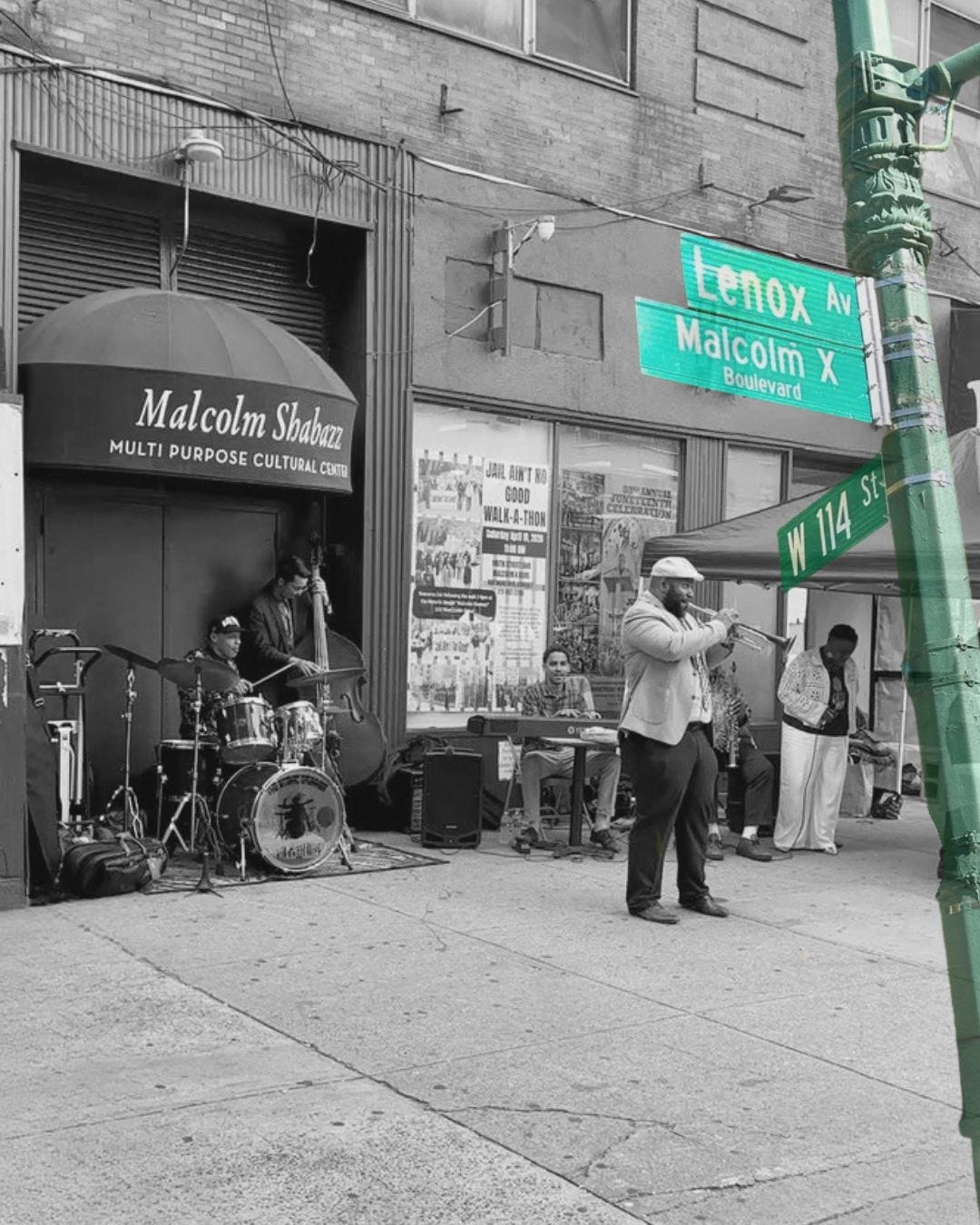
The photograph that started this chapter was taken on the clock. I was in Harlem on an appraisal assignment, and when I walked to the corner I looked up at the signpost. Two names on one pole. The block I was being paid to value had two names, and the sign said plainly that someone had fought over it.
That is what I went looking for this summer. Not streets, but the names on them: a signpost in Harlem, a lamppost banner in NoMa, a row of institution names hanging under a highway in Atlanta. Names are the cheapest thing a neighborhood owns and the first thing to change hands when the land underneath gets valuable. A name costs nothing to give. It is the hardest thing to take back once it holds. And it moves a property’s value before a single building is touched.
Three neighborhoods, then. Watch what the name does in each.
Harlem. Lenox Avenue on top, Malcolm X Boulevard underneath. Neither name has erased the other; they share the pole. Lenox came first, from a surveyor’s hand, for Robert Lenox, a merchant with no connection to the people who would come to live on the street that carried his name. At Harlem’s insistence, the city co-named the avenue for Malcolm X, who held outdoor rallies on the avenue in 1963 and whose mosque, Temple No. 7, stood on it too. The old name still runs on the deeds and the older maps. The name people say is the one Harlem chose.
A community renaming its own street is running the same mechanical act a developer runs when it coins a new district to lift a comp set. Same tool. Both use a name to claim a place. What differs is who the claim is for. When Harlem renamed Lenox, the claim was for the people already there. That is the rarer direction. Most renamings in my trade run the other way: a name reached for to pull a block loose from its past and sell it to someone new.
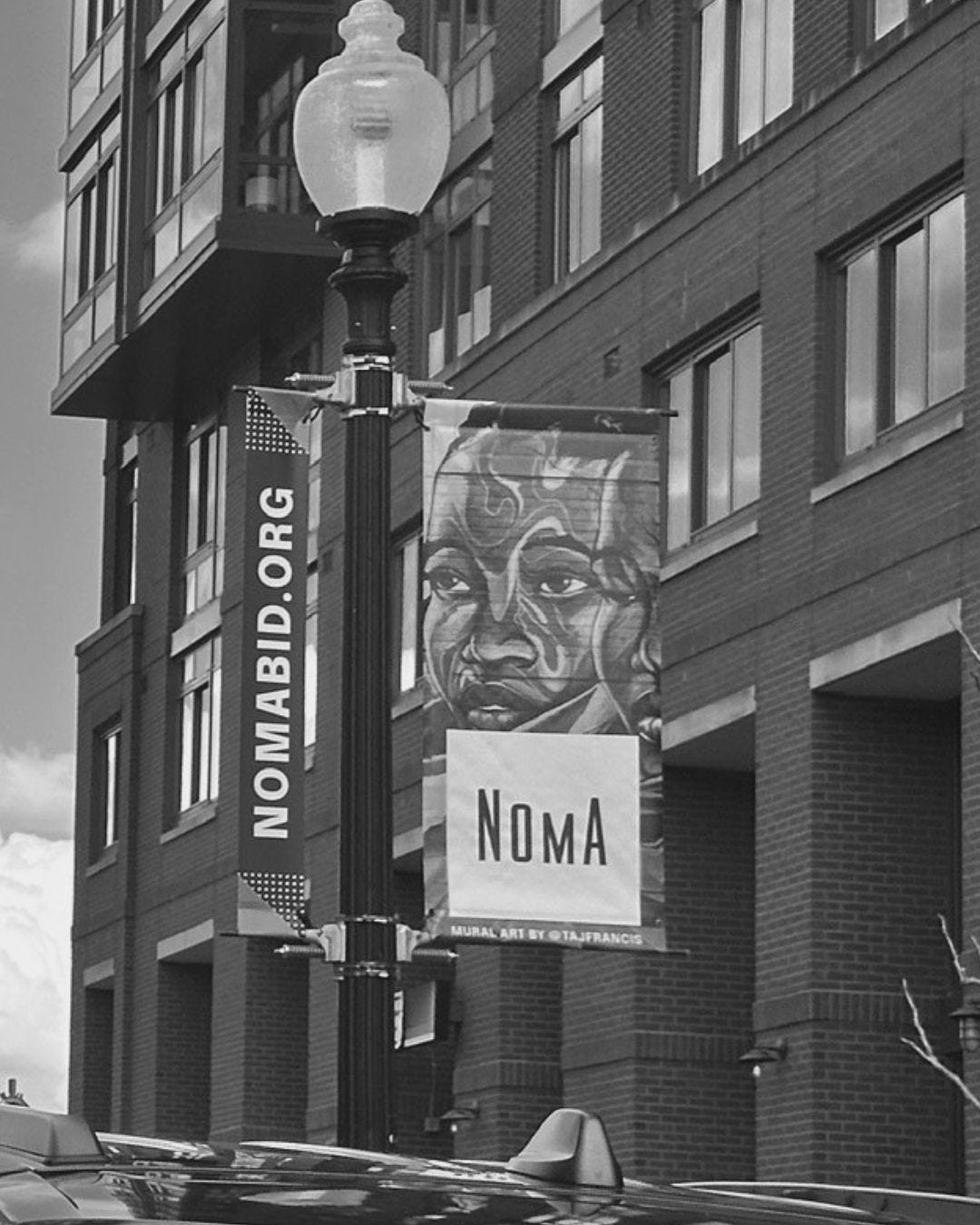
NoMa. Which brings us to the other way. NoMa stands for North of Massachusetts Avenue, coined in the 2000s the way SoHo and NoHo were coined, for land that did not yet have a name anyone wanted: rail yards and warehouses behind Union Station. The name came first, then the towers, then the dog parks, then the rents. Notice what kind of name it is. It is a coordinate. It locates the land by its relation to downtown, a short walk from the Capitol, and sells it on exactly that.
On a building beside Swampoodle Park there is a mural by Joel Bergner: a girl holding a whole city cupped in her hands. The city she holds was painted by third graders from the school down the block. The wall says this place belongs to them. The wall belongs to Union Place, a Toll Brothers building whose leasing copy promises that here, you know you’ve arrived. On the lampposts nearby, the NoMa banners reproduce a different mural, by Taj Francis, whose original wall was redeveloped. The business improvement district commissioned the children’s mural, kept the picture of the demolished one, flies the name, and lists the building in its neighborhood guide. The children are real and the mural is sincere. It is also part of what makes the ground worth more. Harlem renamed a street to stay. NoMa was named to be sold.
Sweet Auburn. The third case holds both directions at once, across seventy years, and it is the one that shows what proximity has to do with any of it.
The street has had three names. It was Wheat Street until 1893, when the city renamed it Auburn Avenue. John Wesley Dobbs gave it the name people actually use, and he was precise about why it was sweet. Not only the money, though there was money: shut out of white credit, the community built its own banks and insurers, and Fortune, in 1957, called Auburn Avenue the richest Negro street in the world. Dobbs named the location too. Sweet Auburn sat adjacent to the white business district, he said, “not across the tracks.” The value was the nearness to downtown.
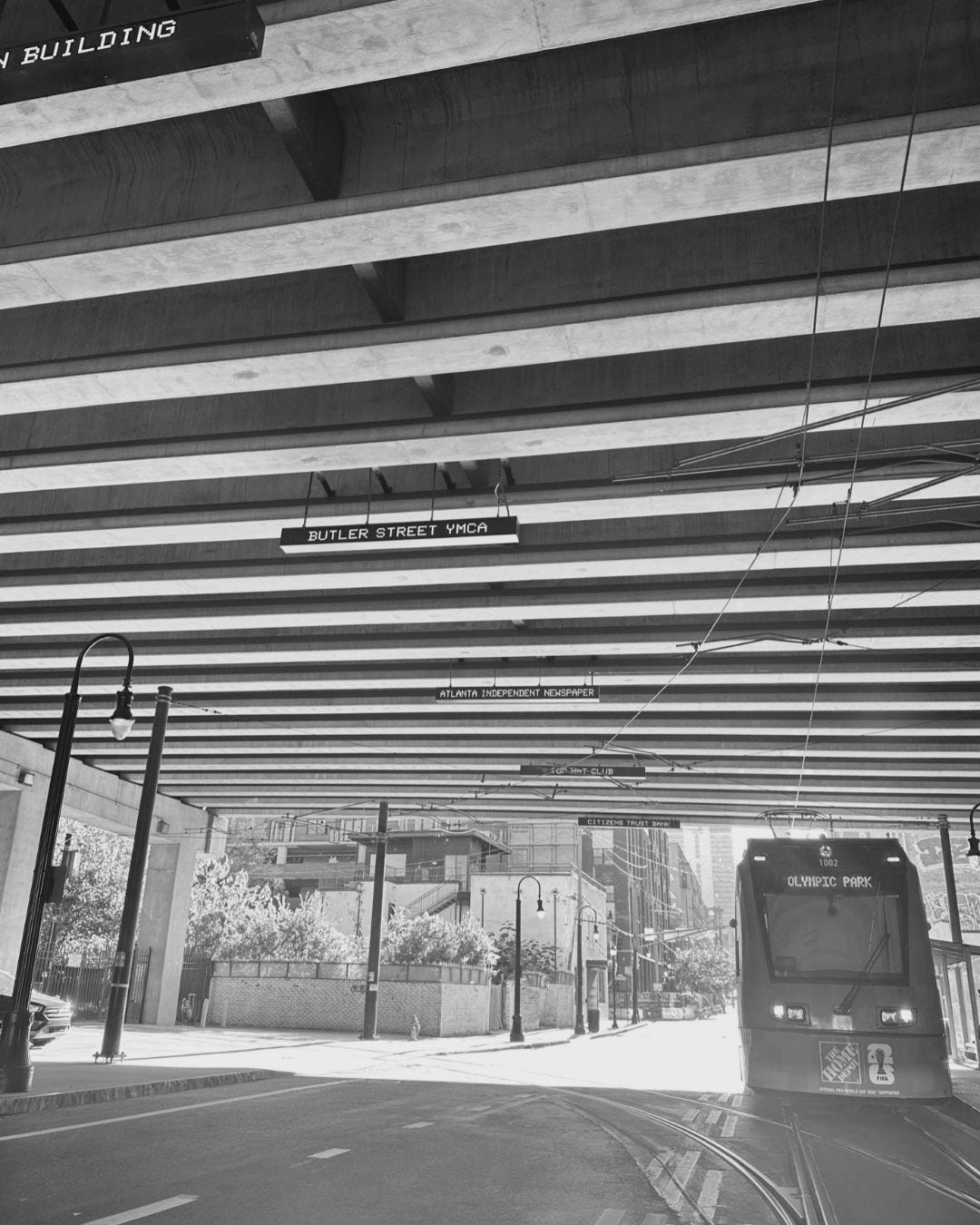
That nearness is what came for it. In 1958 the state began cutting the Downtown Connector through the neighborhood. The first route would have taken the community’s own banks. Neighbors fought it a few blocks east, saved the institutions, and lost the surrounding blocks instead. Today the names of the street’s institutions, Atlanta Independent Newspaper, Citizens Trust Bank, the Butler Street YMCA, hang as signs on the underside of the highway. And the same nearness that made the land worth taking makes it worth having again. The neighborhood is coming back in pieces, on the strength of the name: the history, the King association, the phrase itself, which is now less a memory than an asset. The name Dobbs gave the street to hold it has become the instrument that makes it worth taking a second time.
Put the three side by side and the naming turns out to rest on something underneath it: land close to downtown.
Proximity is the constant, but it does something different in each place. In Sweet Auburn it was the value the founder named, and the reason the neighborhood lay in the highway’s path; the road bent east through it rather than through the business district to the west. Walk Auburn Avenue now and the lampposts carry two banners. One says Sweet Auburn. The other says Downtown ATL. The nearness Dobbs named as the street’s value is becoming the name that absorbs it. In NoMa it was the whole product: a rail yard became a neighborhood by being renamed as a location. In Harlem it is pressure. This is Manhattan land that has never stopped being contested, and a community’s name has to keep holding on it. In every case the name is how the claim to that ground gets made, and it gets made in both directions. A community names a street to hold it. A developer coins a district to sell it. Someone bolts the names of a street’s institutions to the underside of the highway that took the blocks around them, and calls it honoring.
So the name is never decoration. It is the visible surface of a transaction that anyone holding a deed already understands. Watch the names and you can read who is claiming the ground, and whether the claim is for the people on it or for whoever comes next.
The names are still up in all three places. Read them the way you’d read a deed: for who they were written for.
Names ran through August: Harlem, NoMa, and Sweet Auburn. Read the field notes → Next month, The Cut: what a highway does to a neighborhood, beginning where Sweet Auburn left off.
New to Map & Parcel? Start with Painted Claims →, the essay that opened the series.
— Eve Moss
Map & Parcel™ is a publication of Chavah Media Ltd. This essay is editorial and for general interest only; it does not constitute legal, financial, or investment advice.
© 2026 Chavah Media Ltd. | Map & Parcel™. All rights reserved.